For independent orthodontic practices
Your systems each see part of your practice. We connect them.
Nobody has ever looked at them together, so no one sees what falls between them. Archwire connects the systems you already use, finds what none of them can see alone, and fixes what’s costing your practice the most, without changing how your team works.
The systems you already use
Practice software
knows the schedule
Financing and payments
knows who signed
Phones and texting
knows who called
Labs and shipping
knows what was ordered
Scans and aligners
knows what was scanned
What none of them sees alone
Where your practice is losing the most
What your team gets
A fix built for your practice, with a number we check at 30 days
- No new software for your team
- Fewer tasks, not fewer people
- If a fix’s number doesn’t move in 30 days, the next month is free
You picked each system because it does one job best, so they’ll never be one system. The gaps between them are where things slip through.
How it works
The Archwire Method: Listen, Connect, Pick, Wire.
Every practice is different, so we don’t show up with a fix. We find yours. Your team tells us where to look, your systems show what’s really happening, and together they turn up what no consultant’s playbook would.
-
Listen
We interview every role.
Doctor, front desk, treatment coordinator and clinical assistants, with questions written for orthodontic practices.
You get the Practice Map
-
Connect
We line up the systems you already use, patient by patient.
We only read. Nothing to install, and nothing new for your team to learn.
Read-only
-
Pick
We rank where you’re losing the most. You pick one to three.
What your team told us goes next to what your systems show. We sort every step: drop it, automate it, give it to AI, or keep it with a person. Each fix gets a starting number.
You get the Practice X-Ray
-
Wire
We build each fix and check its number at 30 days.
Often it’s the right list for the right person on the right day, but it’s whatever your practice needs. Then on to the next one.
You get the 30-Day Scorecard
Our guarantee
If a fix’s number doesn’t move within 30 days of going live, you don’t pay for the next month.
You don’t have to know how every job works.
Most doctors don’t. We ask the people who do the work.
What it looks like
What you get, straight from the Archwire app
The Practice Map, the Practice X-Ray, and the 30-Day Scorecard for a made-up demo practice. Your practice’s data stays private.
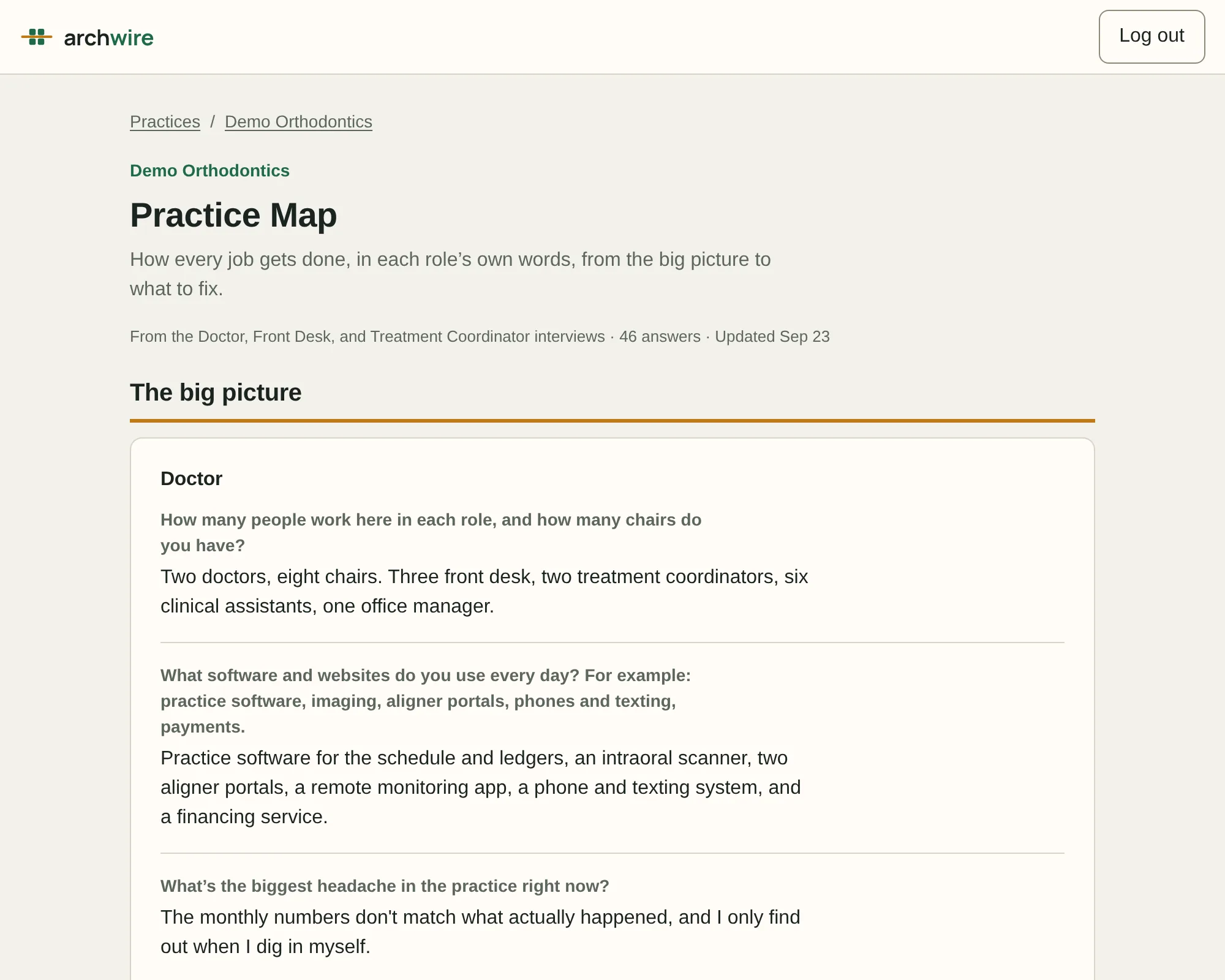
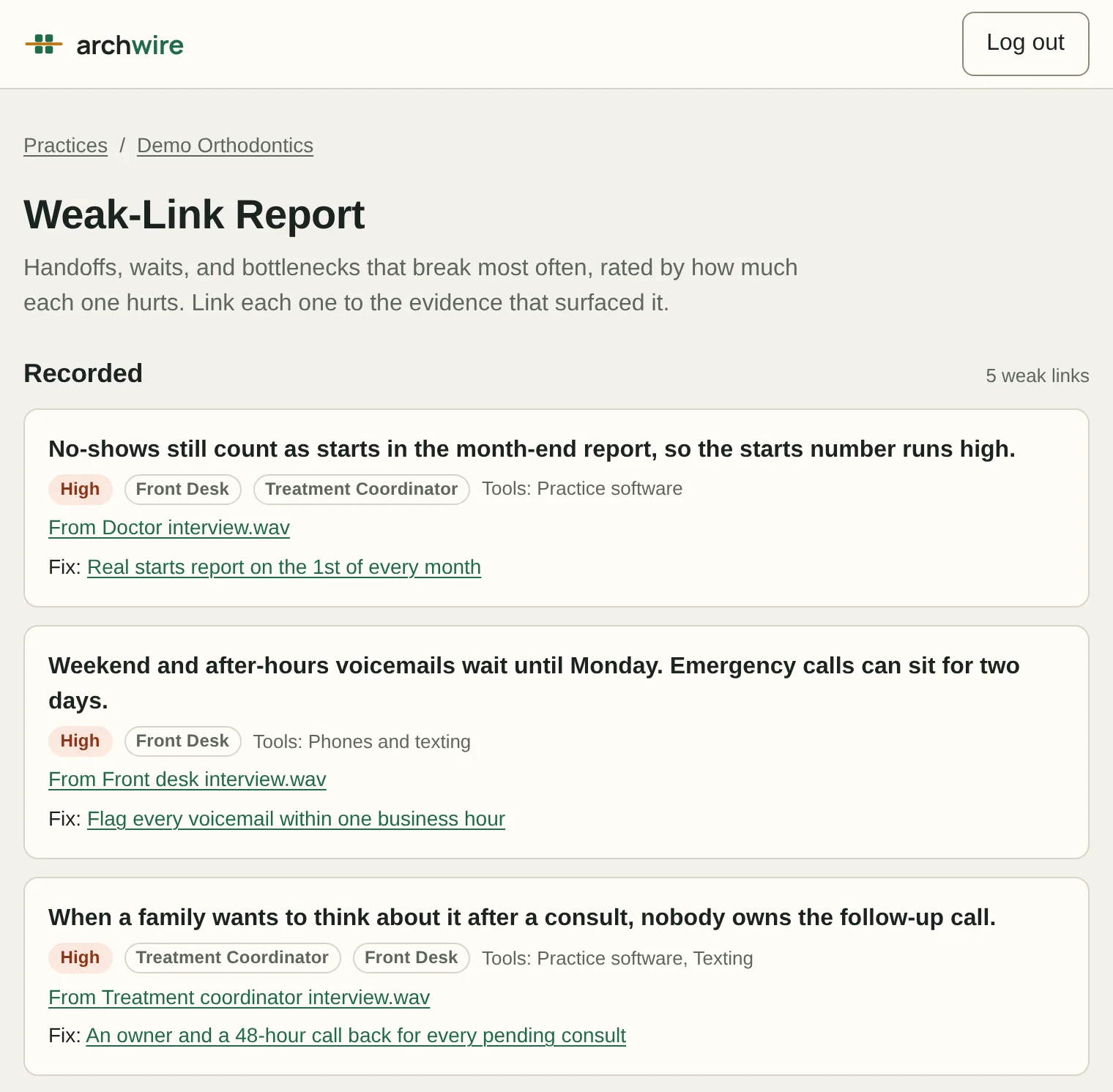
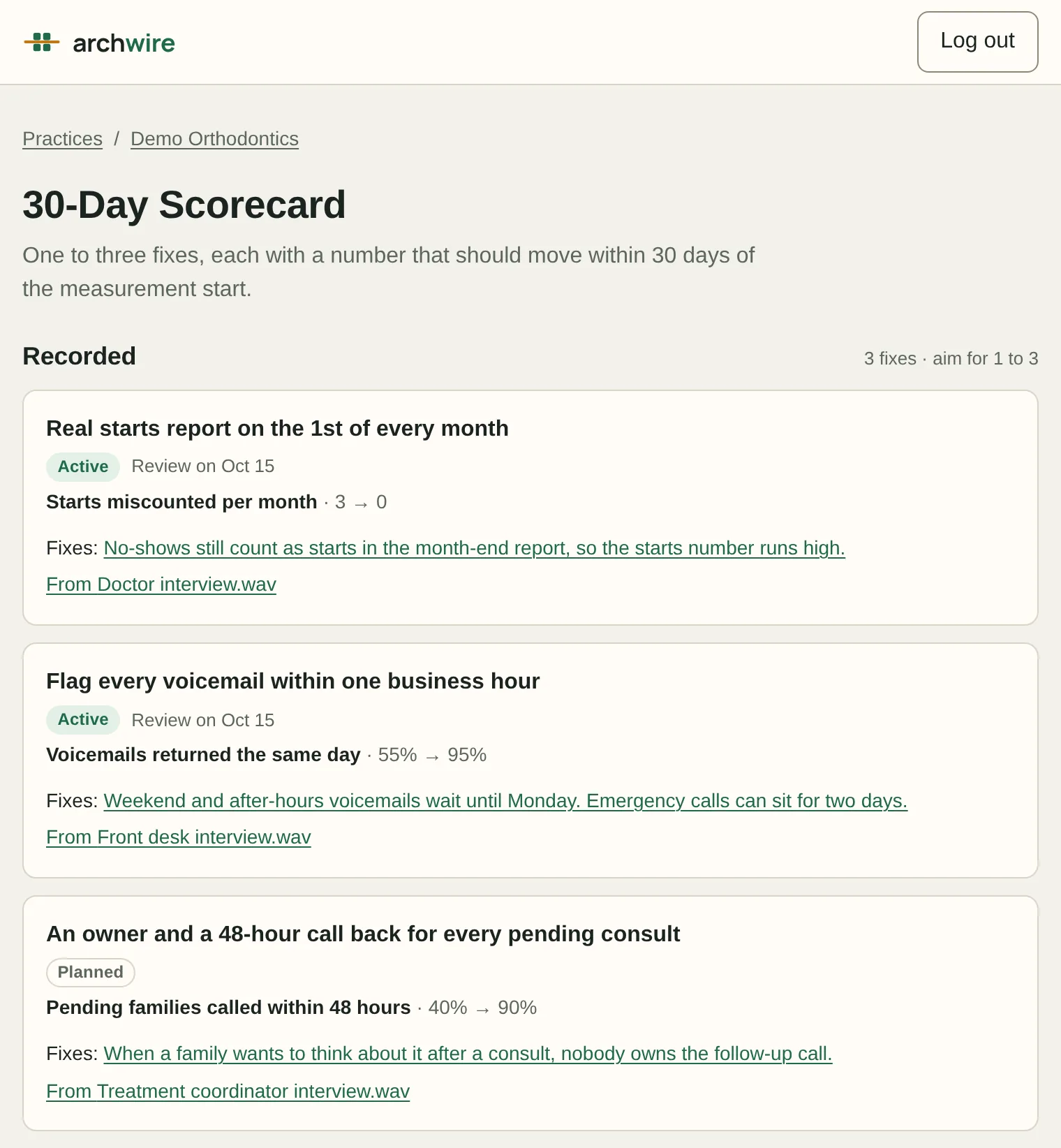
Case study · Our first founding practice
What the Archwire process found at a three-office orthodontic practice
4 roles
interviewed: doctor, coordinator, front desk, clinical assistant
8 systems
they already used, connected
Within a week
of the first interview, the first reports reached the doctor
The eight: practice software, financing, phones, two outside labs, the in-house lab’s ordering portal, shipment tracking, and a shared drive.
Here’s what surfaced
244
observation patients 9 and older with no panoramic X-ray in a year and nothing booked.
Only 7 had been contacted in the past three months
$490,000
in proposed treatment for 109 patients who booked a start and didn’t start, or were still deciding
45
patients who had dropped off the follow-up list with no decision either way
20 of 58
aligners, appliances, and retainers due the next week needed a fix before the patient arrived
Things no single system could show
Practice software
Still on observation
Financing system
“Do not pursue”
74 children were both at once. Neither system knew the other disagreed.
And 14 children had missed an eruption check that was never rebooked.
2 expanders
ordered under another office’s lab account, so they were shipping to the wrong office.
3 of 19
aligner packages since August went to a UPS pickup location instead of the office.
The reports we built for them
These three are what this practice needed. Yours might need something else. That’s what the process finds out.
Families who haven’t started
Every family with a consult who hasn’t started, grouped by what happened, with the treatment value, the last real contact, and the next step.
- Practice software
- Financing
- Phone logs
Observation patients
Who’s due now, who’s overdue, and who to close out, with the last real contact for each family. At two offices that meant reading about 4,500 contact notes.
- Practice software
- X-ray dates
- Financing
- Calls and texts
Next week’s custom items
Every visit next week that needs an aligner, appliance, or retainer, checked against lab orders and shipping, so a missing item is caught before the patient sits down.
- Practice software
- 3 lab portals
- Shipment tracking
- Scan sheets
What happened next
The treatment coordinator went through the observation list with the doctor and started calling families that same day.
The doctor created a remote role to work the lists across all three offices every month.
The doctor rated the first round about 85% right. Every correction becomes a rule for the next run, so each round gets sharper.
Numbers are from the first reports, September 2026. Treatment value is the proposed fee on each family’s contract, not money collected. Every report is checked by independent reviewers against the raw data before it goes out.
One start a month pays for it several times over.
We work on what’s costing your practice the most, and every fix comes with a number we check 30 days after it goes live.
A setup fee, then a flat monthly fee that’s a small fraction of what one new case brings in. You get the exact price on the free 20-minute call, before any work begins.
Questions doctors ask
How much of my time does this take?
It starts with a free 20-minute call. If you go ahead, each role’s interview takes about an hour, yours included, and we schedule around patients. Someone on your team also helps us set up a login for each system once.
I don’t know how every job here works. Is that a problem?
No. Most doctors don’t, and you don’t need to. We interview the people who do each job and put it all together.
Does this involve patient data?
Yes. Finding what your systems miss means reading your patient records. We only read, and we go through exactly what we look at, and where it’s kept, with you before connecting anything. Reports that name patients stay behind a sign-in in the Archwire app, and our emails never include patient names.
Will my team push back?
Usually the opposite. The goal is fewer tedious tasks, not fewer people. We take work off their plate, add nothing new for them to learn, and the interviews give them a say in what gets fixed.
Will you change how we practice?
No. Fixes fit how you already run your practice, not a consultant’s one-size playbook.
Do we have to switch software or learn anything new?
No. Archwire works on the systems you already have. Your team gets what we find as a list, a report, or a heads-up by email, not another system to log in to every day.
Which systems do you work with?
So far: Cloud 9, OrthoFi, RingCentral, Clarity, Motor City, Easy RX, and Google Drive. If a system has a web login, we can usually connect it. If yours isn’t on the list, ask.
How is this different from a practice consultant?
Consultants bring a playbook, talk to your team, and leave you a to-do list. We interview your team too, then connect your systems and look at what actually happened, patient by patient. Then we build the fixes ourselves and check each number 30 days after the fix goes live.
We already use Gaidge or other practice reports. How is this different?
Keep them. Reports count what happened: starts, collections, how many families said yes. We connect all your systems and look patient by patient, including the notes, calls, and lab orders that reports don’t read. That’s how we find what no single report can show. Then we build the fix and check that its number moved.
What does it cost?
A setup fee, then a flat monthly fee that’s a small fraction of what one new case brings in. You get the exact price on the free 20-minute call, before any work begins. And if a fix’s number doesn’t move within 30 days of going live, you don’t pay for the next month.
My treatment coordinator just gave notice. Is it too late?
No, but get in touch now. We interview them first, while what they know is still in the building, and your Practice Map keeps their job written down for whoever comes next.
Only orthodontics. Only five founding practices.
We work only with independent, owner-operated orthodontic practices, where the doctor sets how things run. To do each one well, we’re starting with five. Founding practices get founding pricing in exchange for a case study.
Opens an email to hello@archwire.ai